- Product Design
- Full-Stack Development
BrightGrid
A client portal for a Dutch electrical contractor, now growing into a multi-tenant SaaS
- Timeline
- 2026 (ongoing)
- Tools
- Next.js
- React
- TypeScript
- PostgreSQL (Neon)
- Drizzle ORM
- Auth.js
- Tailwind CSS
- next-intl
- Resend
- Challenge
- The contractor needed one place where every client could follow a job from the first request to the final invoice, in Dutch, English or Romanian.
- My role
- Sole Product Designer & Full-Stack Developer
- Outcome
- In progress: a trilingual portal from request to invoice, becoming Nexyra, a client portal for any contractor
The Problem
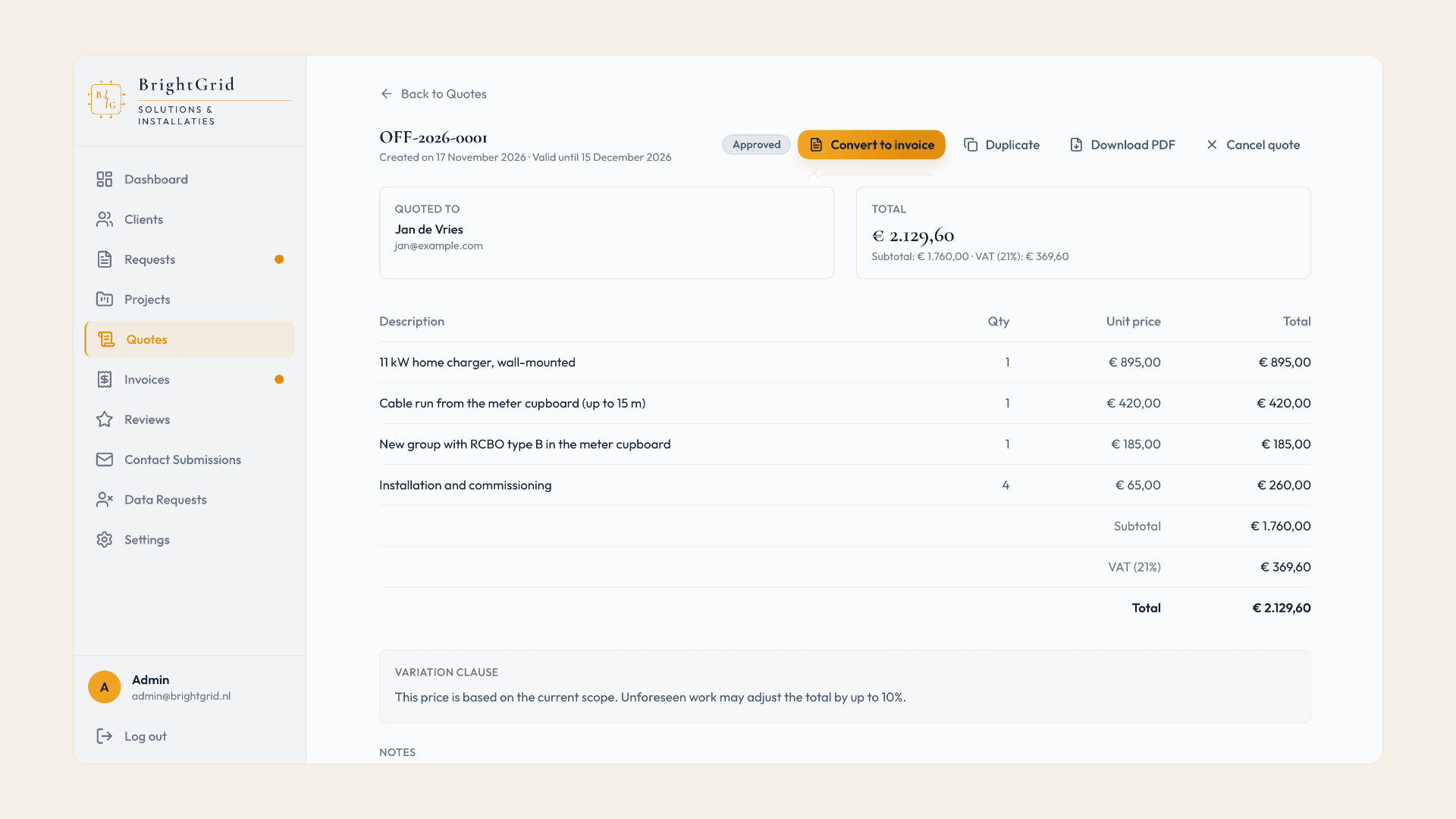
BrightGrid Solutions & Installaties is an electrical contractor in the Netherlands: KNX home automation, panel building, sustainable energy and EV chargers. It needed a public site that earns the trust of homeowners and businesses, and a portal behind it for the work itself.
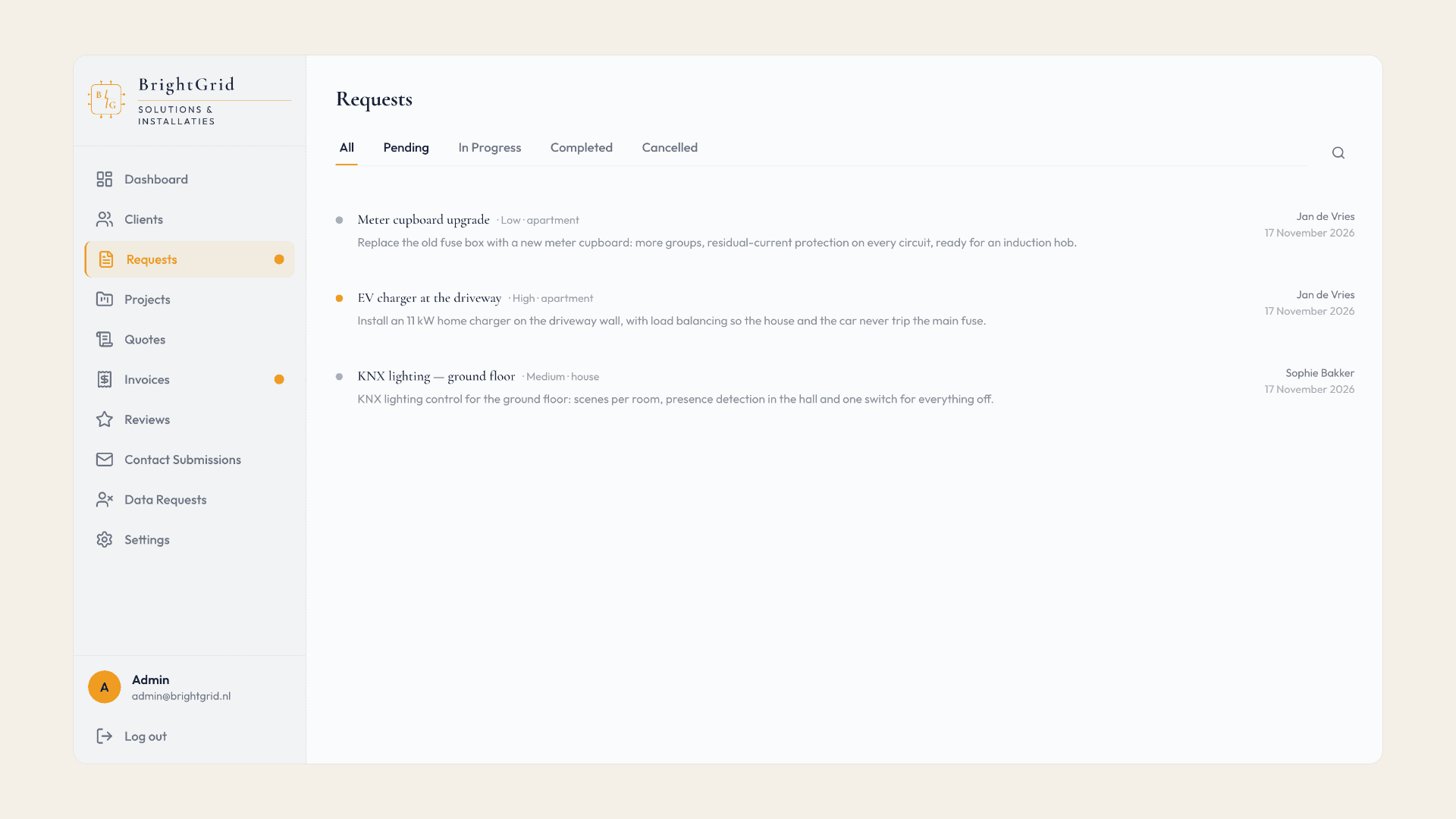
The contractor needed one place where every client could follow a job from the first request to the final invoice, in Dutch, English or Romanian. The owner needed the other side of it: clients, requests, quotes, projects and invoices in one dashboard, with the paperwork Dutch clients expect (BTW on every invoice, formal Dutch in every email).
The contractor’s services
- KNX home automation
- Panel building
- Sustainable energy
- EV chargers
Design Decisions
- 01
One pipeline from request to invoice
A client’s request becomes a quote, an approved quote a project, and a completed project its own draft invoice.
Why: Each step starts from what the last one already knows (the client, the address, the items), so the owner never types a job twice, and the client sees the same job move through the portal.
From request to invoice
- Request
- Quote
- Project
- Invoice
- 02
Quotes clients approve from a link
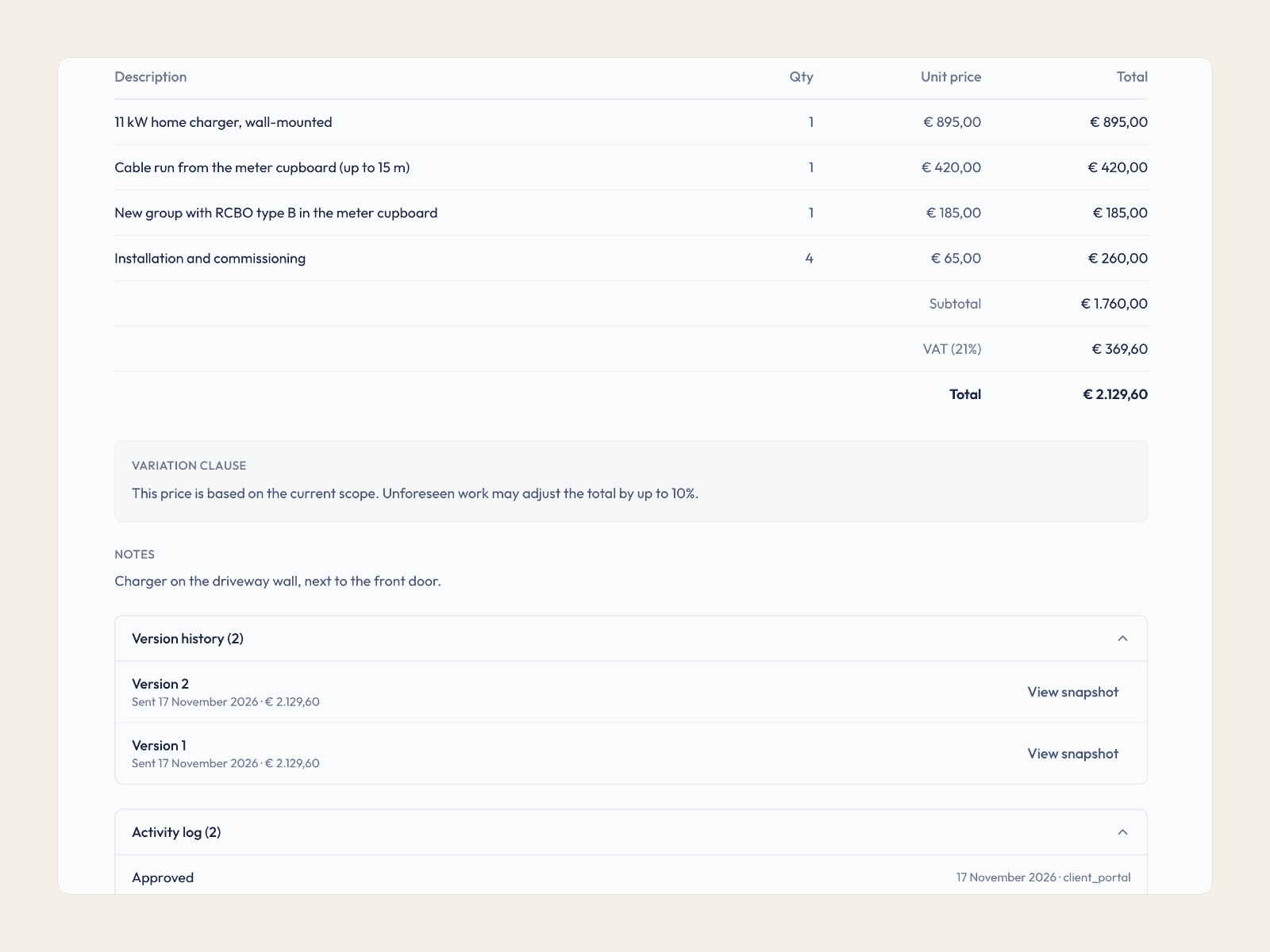
Every quote is versioned, numbered by year (OFF-2026-0001) and sent with a signed link the client opens to approve or reject it, no account needed.
Why: A quote is a negotiation: the version history and audit log show what changed and who agreed to what, and a reminder goes out three days before it expires.
- 03
Clients join with a code
The portal has no open sign-up: the owner gives each client a registration code.
Why: The portal holds addresses, quotes and invoices. Only the contractor’s own clients belong in it.
Joining the portal
- Owner issues a code
- Client registers
- Client portal
- 04
Privacy built into the product
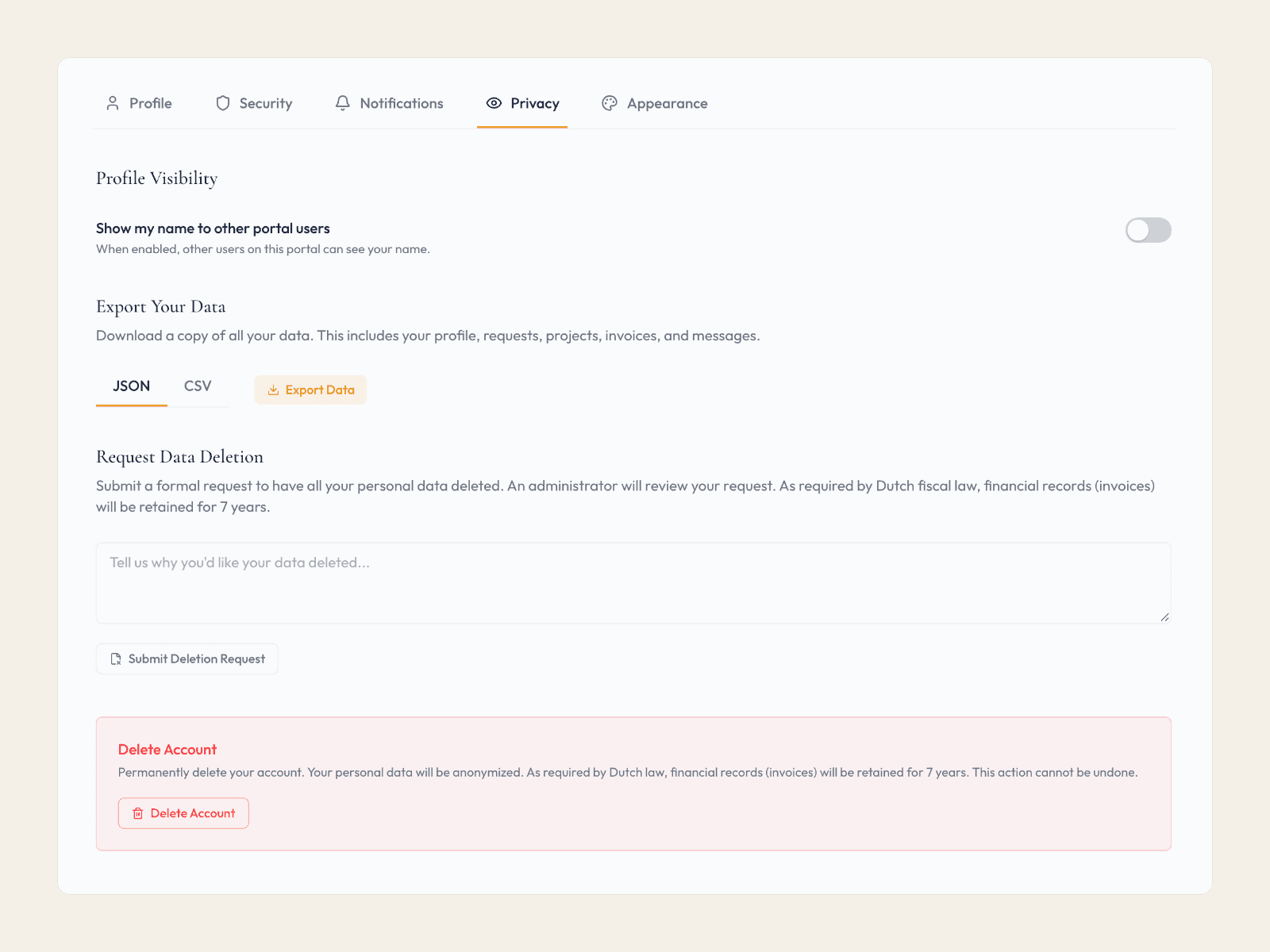
Personal fields are encrypted in the database, accounts can use two-factor authentication, and clients download their data or ask for its deletion from the portal.
Why: Under the GDPR those requests are the contractor’s to answer. Built into the dashboard, a deletion request is a task with a status, not an email that gets lost.
- 05
One codebase for every contractor
When the client stepped away, I rebuilt the portal as Nexyra: each contractor signs up, gets a subdomain and a portal in their own brand, and BrightGrid stays as the live demo.
Why: What BrightGrid needed (quotes, invoices, a client portal, GDPR tooling) is what every installer needs. Row-level security in PostgreSQL keeps each contractor’s data apart, whatever a query forgets.
A new contractor on Nexyra
- Sign up on nexyra.app
- Own subdomain
- Branded portal
The Solution
- Public site in Dutch, English and Romanian, each language at its own address, with services, FAQ and local business structured data
- Client portal: requests, quotes, projects and invoices, with a message thread per request
- Versioned quotes with signed approval links, converted to invoices with 21% BTW, both as PDFs in the client’s language
- Owner dashboard: clients, requests, quotes, projects, invoices, reviews and data requests
- Email notifications in three languages and web push
- Two-factor authentication, encrypted personal fields, rate limiting and password reset
Impact & Learnings
Work in progress: Nexyra is being built now, and BrightGrid runs as its live demo.
Where it stands
3
languages: Dutch, English and Romanian
10 weeks
from the first commit to a multi-tenant SaaS
222
test files across the app
- The client stepped away, so the portal is becoming Nexyra: self-serve sign-up, a subdomain and a brand per contractor, with BrightGrid as its live demo
- Accessibility pass on the site and dashboard: skip links, keyboard-operable menus, focus kept inside dialogs
- Lint, tests and a production build run on every pull request
What I learned
- A client project can end without the product ending: separating what was BrightGrid’s from what every contractor needs turned it into a product.
- Paperwork is the product for a contractor. The quote, the invoice and the reminder matter more to them than the homepage.
What I’d Do Differently
- Settle the visual direction before building screens. The interface went from black and gold to navy and gold to a minimalist dashboard, and each change reworked pages already built.
- Design for several tenants from the first table. Nexyra had to add the tenant to every table and query afterwards.